
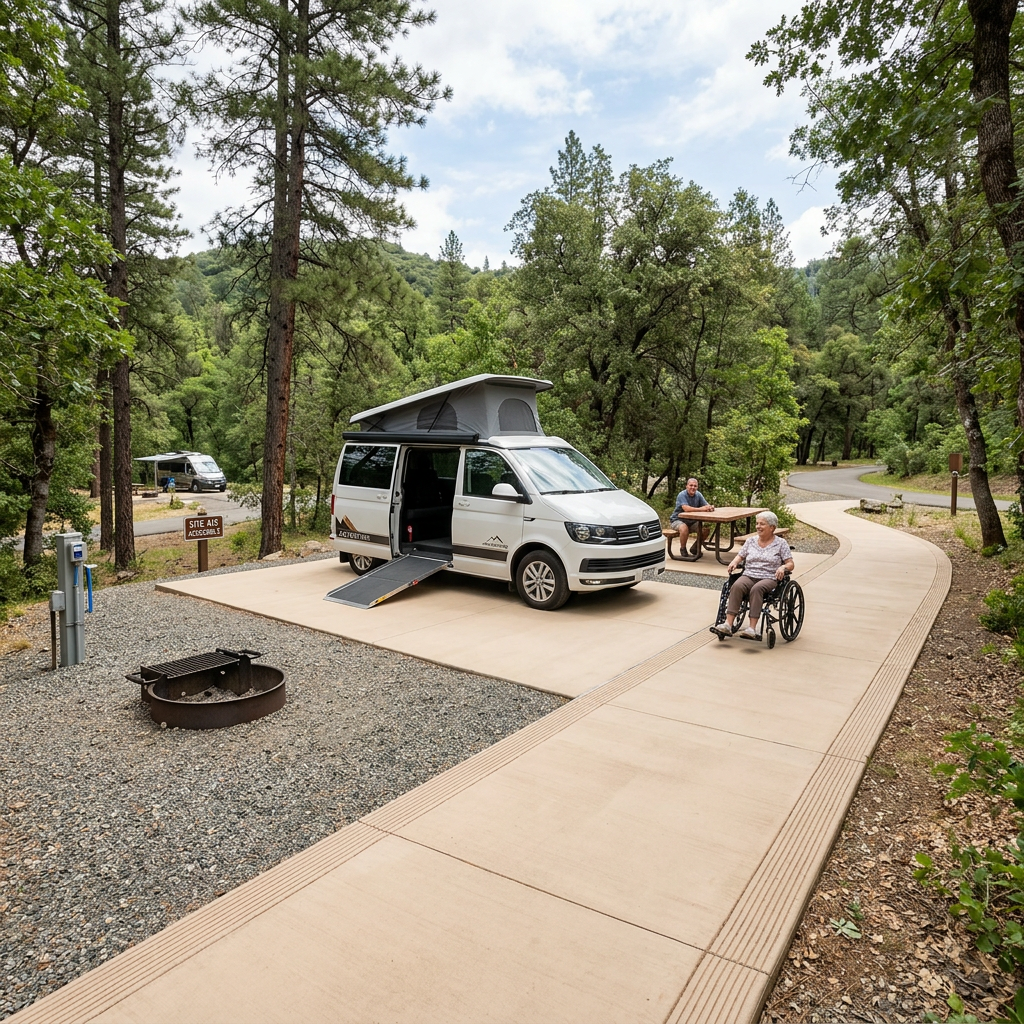
Finding the right campsite can make a significant difference to the comfort and enjoyment of any campervan trip.
For travellers with mobility requirements, long-term health conditions, sensory sensitivities or other accessibility needs, campsite facilities often play an even more important role.
While many campsites advertise themselves as accessible, the reality can vary considerably between locations.
Accessibility is about much more than simply having an accessible toilet.
Pitch layouts, pathways, parking arrangements, shower facilities and site design can all affect how easy a campsite is to use.
This guide explains what to look for when assessing accessible campsite facilities and how to choose locations that support comfortable and enjoyable travel.
For a broader overview, see Accessibility & Inclusive Campervan Travel Guide (2026 Edition).
Why Campsite Accessibility Matters
A campsite may look ideal online but still present challenges in practice.
Accessibility can influence:
- Comfort
- Safety
- Independence
- Convenience
- Overall enjoyment
Good facilities can reduce physical effort and improve confidence throughout a trip.
Accessibility Means Different Things to Different People
Not all accessibility needs are the same.
Travellers may require support relating to:
Mobility
Wheelchair Use
Long-Term Health Conditions
Sensory Needs
Fatigue Management
Age-Related Challenges
The most suitable campsite will depend on individual circumstances.
Don’t Rely Solely on Accessibility Labels
Many campsites use terms such as:
- Accessible
- Disabled-friendly
- Inclusive
- Mobility-friendly
While these descriptions can be helpful, they do not always provide enough detail.
It is often worth checking exactly what facilities are available before booking.
Accessible Toilet Facilities
Accessible toilets are one of the most commonly requested facilities.
Factors to consider may include:
Door Width
Internal Space
Grab Rails
Transfer Space
Ease of Access
Not all accessible toilets offer the same level of usability.
Accessible Shower Facilities
Showers can vary significantly between campsites.
Potential considerations include:
Step-Free Access
Shower Seating
Grab Rails
Space for Assistance
Non-Slip Flooring
Comfortable shower facilities can greatly improve the camping experience.
Pathways and Site Surfaces
Surface conditions often affect accessibility more than individual facilities.
Common surfaces include:
Tarmac
Concrete
Paving
Gravel
Grass
Mixed Terrain
Weather conditions can dramatically change how accessible a surface remains.
Pitch Accessibility
Not all pitches are equally accessible.
Useful considerations may include:
Level Ground
Surface Quality
Distance to Facilities
Ease of Vehicle Access
Space Around the Campervan
Related article:
➡ Accessible Parking for Campervan Travellers
The most convenient pitch is not always the nearest available pitch.
Space Around the Pitch
Additional space may be required for:
Wheelchair Access
Mobility Scooters
Walking Aids
Vehicle Ramps
Wheelchair Lifts
Travellers should assess both vehicle access and personal movement requirements.
Distance to Key Facilities
Large campsites may require significant walking.
Before booking, consider distances to:
Toilets
Showers
Reception Areas
Shops
Laundry Facilities
Waste Disposal Points
Reducing walking distances may improve comfort and conserve energy.
Accessible Parking on Campsites
Parking arrangements can affect accessibility considerably.
Helpful factors include:
Flat Surfaces
Adequate Space
Convenient Locations
Good Lighting
Related article:
➡ Accessible Parking for Campervan Travellers
Accessibility often begins before travellers even leave their vehicle.
Wheelchair Accessibility Considerations
Wheelchair users may require additional information.
Potential questions include:
Are Pathways Step-Free?
Can Ramps Be Deployed Easily?
Are Facilities Large Enough?
Are Surfaces Suitable for Wheelchair Use?
Related article:
➡ Wheelchair Accessible Campervans Guide
Detailed information is often more valuable than generic accessibility claims.
Accessibility for Limited Mobility
Travellers with limited mobility may benefit from:
Handrails
Short Walking Distances
Stable Surfaces
Good Lighting
Reduced Slopes
Related article:
➡ Travelling with Limited Mobility in a Campervan
Small details can make a significant difference.
Sensory-Friendly Campsites
Accessibility extends beyond physical mobility.
Some travellers may prefer:
Quiet Locations
Reduced Traffic
Predictable Environments
Lower Noise Levels
Less Crowding
Related future articles:
- Autism-Friendly Campervan Travel
- Sensory-Friendly Campervan Living
The environment itself can influence comfort.
Healthcare and Emergency Access
For some travellers, healthcare access may be an important consideration.
Factors may include:
Nearby Pharmacies
Medical Facilities
Emergency Access Routes
Reliable Mobile Signal
Related future article:
➡ Accessing Healthcare While Touring the UK
Preparation provides additional peace of mind.
Campsite Accessibility Information
When researching campsites, look for information regarding:
Facilities
Photographs
Site Maps
Accessibility Statements
Reviews
The more information available, the easier it becomes to assess suitability.
Contact Campsites Directly
Accessibility information online may be limited.
Contacting a campsite directly can help clarify:
Pitch Availability
Surface Conditions
Facility Details
Accessibility Features
Specific Requirements
Direct communication often provides the most accurate information.
Seasonal Accessibility Considerations
Accessibility can change throughout the year.
Potential seasonal challenges include:
Muddy Ground
Ice
Flooding
Reduced Daylight
Maintenance Work
Conditions that are manageable in summer may be more difficult during winter.
Accessibility for Full-Time Travellers
Full-time travellers may rely heavily on campsite facilities throughout the year.
Long-term considerations may include:
Consistency
Reliability
Comfort
Accessibility Standards
Related articles:
- Living in a Campervan Full-Time
- Full-Time Vanlife Guide
Small improvements can significantly affect the everyday quality of life.
Common Mistakes When Assessing Campsites
Assuming Accessibility Means Fully Accessible
Ignoring Surface Conditions
Overlooking Walking Distances
Failing to Check Pitch Locations
Not Contacting the Campsite
Many issues can be avoided through research and preparation.
What Experienced Travellers Look For
Experienced, accessible travellers often prioritise:
Practical Facilities
Reliable Information
Convenient Layouts
Good Surfaces
Accessibility Consistency
Realistic Expectations
Their focus is usually on usability rather than marketing descriptions.
Accessibility Is About Confidence and Comfort
Good campsite facilities help travellers:
- Feel more independent
- Conserve energy
- Travel with confidence
- Reduce unnecessary stress
- Enjoy their surroundings
Accessibility benefits everyone, not just those with specific mobility requirements.
Final Thoughts
Accessible campsite facilities can play a major role in creating enjoyable and stress-free campervan trips.
While accessibility standards vary between locations, understanding what to look for can help travellers make informed decisions and avoid unnecessary challenges.
By considering factors such as facility design, surface conditions, pitch accessibility and site layout, travellers can choose campsites that better support their individual needs.
Ultimately, the best campsite is not necessarily the one with the most facilities.
It is the one that allows you to travel comfortably, confidently and independently.